Bison Calving Season on the Prairie
Research Home
The Konza Prairie LTER program is based on a conceptual framework that recognizes fire, grazing, and climatic variability as essential and interactive factors shaping the structure and dynamics of grasslands across landscape mosaics. Our LTER goals are to test specific hypotheses regarding the independent and interactive ecological effects of these factors in mesic grasslands, and to evaluate the potential consequences of multiple global change phenomena. Our research program is also designed to elucidate the role of biotic interactions (competition, mutualism, predation, herbivory) in grassland communities and ecosystems, and provide insight into more general ecological phenomenon with applicability to multiple ecological systems. Links under the research tab above provide further information about our "core" LTER research activities, and a variety of other related studies underway at the Konza Prairie LTER site. More detailed information is also available in the most recent of our LTER proposal.
LTER VII began our focus on mechanisms that underlie the sensitivity and resilience of ecosystem states in mesic grasslands. LTER VIII will utilize the array of ecosystem states that have emerged from these manipulations of historical and global 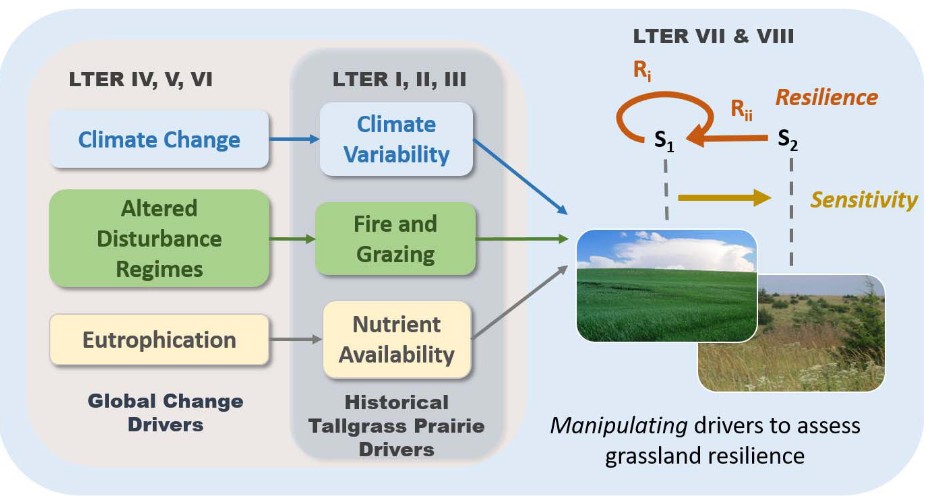 change drivers to refine our understanding of sensitivity, resilience, and ecosystem state change in tallgrass prairie.
To achieve this, our research will focus on four thematic areas:
- Continued watershed-level manipulations of historical drivers (fire and grazing)
- Experimental manipulations of global change drivers
- Cessation or reversal of selected drivers to assess legacies
- Human intervention
Collectively, new KNZ research will advance ecological theory and improve our mechanistic understanding of ecosystem state changes by manipulating key drivers to alter ecological states, while employing new analytical approaches to augment the value of our long-term data sets.